GPR Concrete Scanning
Safe Site Utility Services provides professional concrete scanning for safe, accurate, and efficient detection of embedded features in concrete.
Our GPR technology delivers non-destructive, real-time imaging for cutting, coring, renovation, inspection, and environmental projects of any scale or complexity.
What is Concrete Scanning?
Ground-penetrating radar (GPR) concrete scanning is a fast, precise, and non-destructive concrete inspection method that provides reliable rebar scanning, post-tension cable detection, and concrete slab imaging before drilling, cutting, or coring.
Why Concrete Scanning Matters
Cutting, coring, or drilling without knowing what’s inside the concrete can create serious safety hazards, cause costly structural damage, lead to project delays and rework, and even result in utility strikes or service interruptions. Concrete scanning eliminates these risks by revealing hidden features before work begins, keeping your crew and assets safe.
What We Detect With GPR Concrete Scanning
Our concrete scanning services accurately locate and document:
- Rebar and reinforcing steel
- Post‑tension (PT) cables and tendons
- Electrical conduits
- Plumbing and PVC lines
- Voids, delamination, and air pockets
- Slab thickness and structural geometry
- Embedded metallic & non‑metallic objects
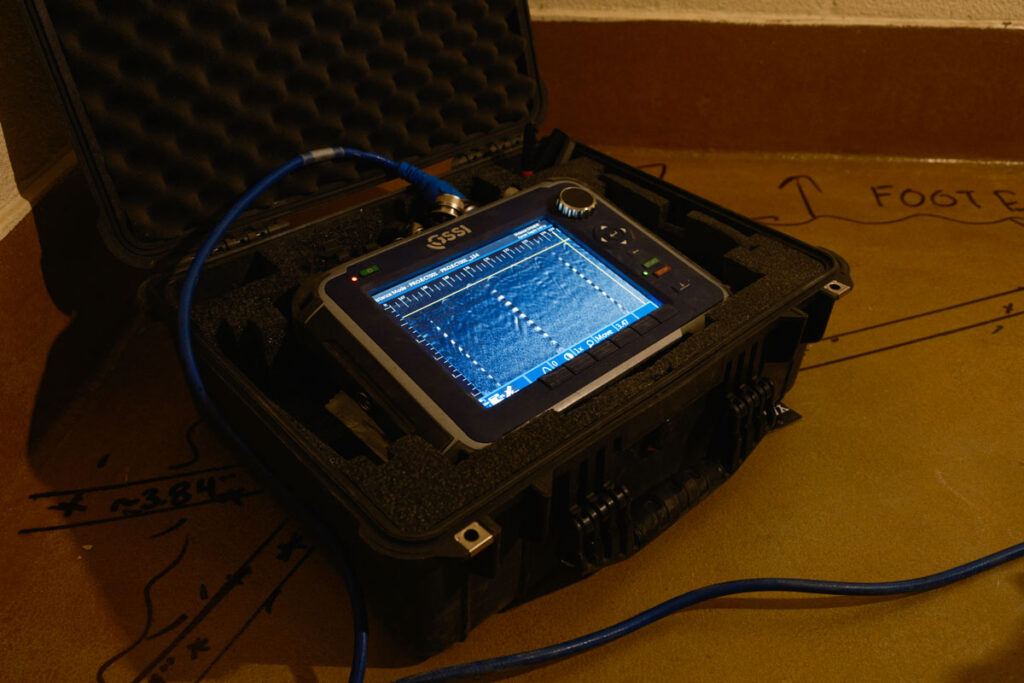
We mark the surface clearly for your crews and provide detailed reports for planning and execution.
Who Needs Concrete Scanning?
Concrete scanning is essential for general contractors, subcontractors, concrete coring and cutting crews, renovation and retrofit teams, structural engineers, as well as facility owners and building managers. Whether you’re working on commercial buildings, industrial facilities, healthcare environments, or infrastructure projects, concrete scanning helps reduce risk and supports smarter decision‑making.
Benefit of GPR Concrete Scanning
Accurate, Safe, and Non-Destructive
Ground-penetrating radar (GPR) concrete scanning is a fast, precise, and non-destructive method for detecting hidden objects in concrete before drilling, cutting, or coring. Unlike X-ray inspection, GPR uses no radiation, making it safe for occupied buildings, confined spaces, and active construction sites. With real-time imaging, GPR helps contractors and engineers identify rebar, post-tension cables, conduits, pipes, and other embedded utilities, reducing risks and keeping projects on schedule.
Key Functions of GPR Concrete Scanning
- Locate embedded objects such as rebar, post-tension cables, conduits, decking, beams, and other subsurface features.
- Detect metallic and non-metallic materials, including pipes, PVC, and other utilities.
- Measure slab thickness and depth to provide accurate engineering and planning data.
- Real-time imaging allows crews to make informed decisions on-site and avoid costly surprises.
Deliverables You Can Depend On
- On-site markings showing precise locations of detected objects for immediate use by field crews.
- Detailed project reports with annotated photos, depth information, and interpretation of findings.
- Improved safety and efficiency by identifying hazards before cutting or coring, helping prevent damage, delays, and rework.
By using GPR concrete scanning, project teams can work confidently, protect workers and infrastructure, and plan every step with reliable, actionable data. Whether detecting rebar, conduits, post-tension cables, or other embedded objects, GPR ensures safe, efficient, and informed construction projects.
Real-World Application Example
Our concrete scanning services have been successfully applied across a wide variety of projects, including:
Commercial Renovations: Scanning floors and walls before cutting or drilling to avoid hitting hidden utilities or rebar.
Industrial Facilities: Detecting embedded pipelines and conduits in slabs for maintenance or expansion projects.
Healthcare Buildings: Safely scanning occupied areas without disrupting patients or staff.
Bridges & Infrastructure: Locating post-tension cables and reinforcement before coring or structural modifications.
Educational Campuses: Scanning classrooms and hallways to prevent structural damage during renovations.
Each project benefits from our non-destructive, real-time GPR imaging, giving teams confidence and precision before starting work.
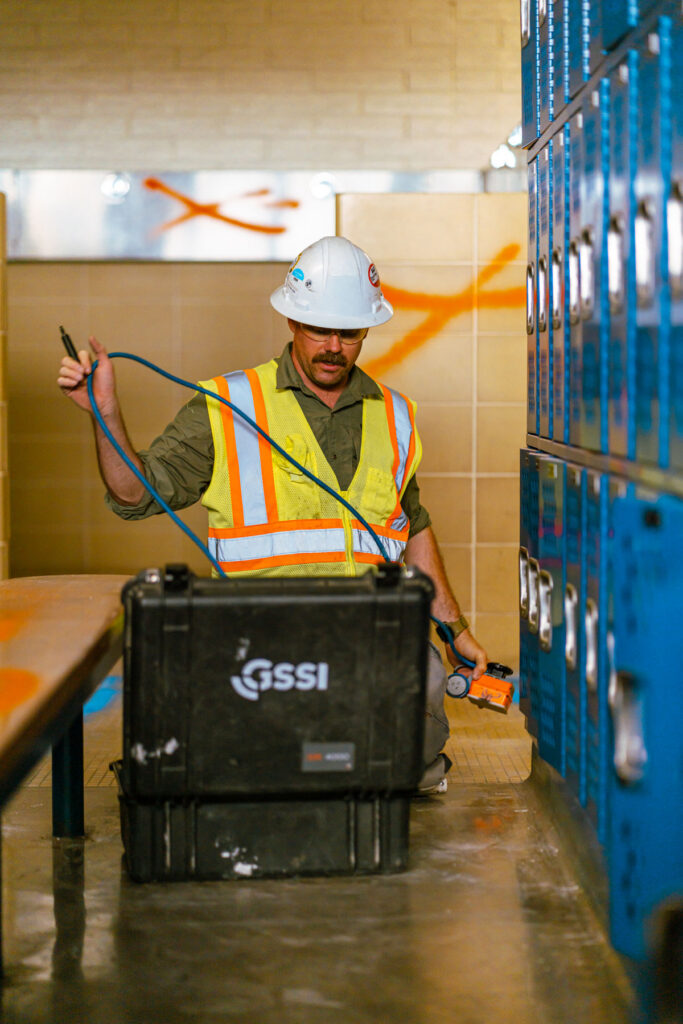
Before coring into a hospital slab, a technician performs GPR concrete scanning to identify and mark:
- Rebar grid (every 12″ spacing)
- Electrical conduit at 2″ depth
- PT cable at 5″ depth
They clear a 2’ x 2’ safe zone for the coring crew—no surprises, no damage
Why Choose Safe Site for Concrete Scanning?
Safe Site stands out by delivering precise, fast, contractor-focused support, with accurate detection of metallic and non-metallic features, real-time field markings, clear reports with photos, and expert technicians experienced across commercial, industrial, municipal, and residential projects. Unlike basic scanning, we provide a complete safety and planning solution.
Our Concrete Scanning Process
Initial Assessment
We review project goals, concrete type, and planned drilling or cutting areas.
On-Site GPR Scan
Our technicians use high-resolution GPR equipment to map embedded features in real time.
Surface Marking
We clearly mark the detected elements directly on the concrete for immediate field use.
Documentation
You receive a detailed report with photos, depth data, and marked findings.
Frequently Asked Questions (FAQs)
Some frequently asked questions to help you understand our service in detail.
How deep will your GPR signal go?
In dry, sandy soils, GPR can penetrate to depths of 50 feet or more. In contrast, moist clay or wet soils absorb the signal, reducing penetration to just 0–3 feet. Even if the signal cannot reach buried utilities in these conditions, it may still reveal trench lines where the clay has been previously disturbed.
What types of objects can you detect inside concrete?
We locate rebar, post-tension cables, electrical conduits, plumbing, voids, and other embedded features. Our GPR technology detects both metallic and non-metallic objects without damaging the concrete.
How quickly can you complete a concrete scanning project?
Scan times depend on slab size and complexity, but our team works efficiently to provide accurate results without delaying your schedule. Most commercial slabs can be scanned in a matter of hours.
Will I receive a report after the scan?
Yes. We provide a comprehensive report including marked photos, depth measurements, and interpretations, giving your crew the information needed to plan core drilling, sawing, or renovation safely.
Can Safe Site scan occupied or sensitive areas?
Absolutely. Our GPR technology is safe for occupied buildings, hospitals, schools, and other sensitive environments since it uses no radiation and does not disrupt operations.
How deep can you dig with vac truck?
Approximately 15’ in moist clay or wet soil and 25’ in dry sandy soil.
Can you find plastic services?
Possibly. Since plastic is non-conductive, electromagnetic locators won’t detect it. We’ll need to use ground penetrating radar, and success will depend on soil type and conditions. Dry, sandy soil offers the best chance, while moist clay or wet soil presents the most challenges.
Can you locate leach fields and geothermal lines?
Most of the time, we can locate leach fields using ground penetrating radar. For geothermal lines without a tracer wire, we also rely on GPR, though success depends on soil type and conditions—dry, sandy soil gives the best results, while moist clay or wet soil makes detection more difficult.
How far can your cameras reach, and how accurate are depth measurements?
With our push camera in 3”–8” pipes, we can reach approximately 300’, while our CCTV tractor camera in 10”–24” pipes can go about 600’. Depth measurements are accurate roughly 85% of the time, so we cannot guarantee exact depths. If precise depth is critical, vacuum excavation to physically expose the utility is the most reliable solution.
Get your project started
with your free quote
Ready to minimize risk and improve project outcomes?
Contact Safe Site today for reliable concrete scanning services and a free project quote.