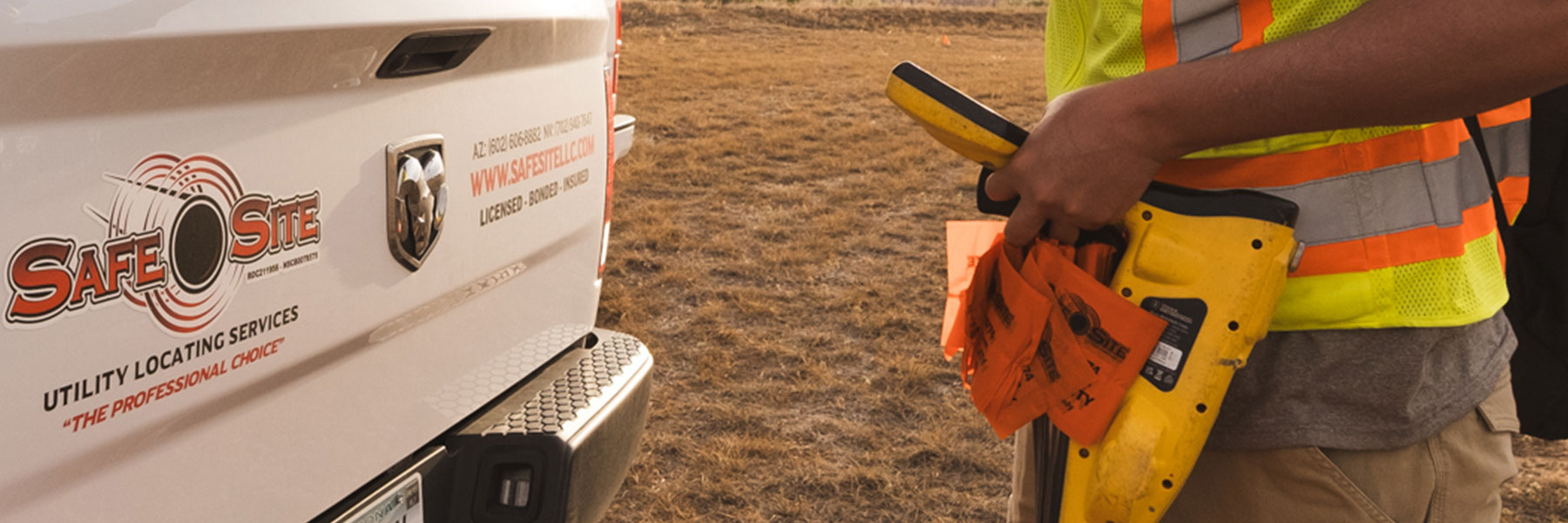
Orange utility markings on a construction site identify underground communication, alarm, and signal lines. Under the American Public Works Association (APWA), orange paint, flags, and stakes indicate buried infrastructure such as fiber-optic cables, telephone lines, cable TV lines, and communication conduits. The APWA also establishes standard colors for other underground utilities, each representing a different type of infrastructure
Protecting these systems is essential during excavation. Communication networks carry the data and signals that businesses, public services, traffic systems, and telecommunications providers rely on every day. Damaging an orange-marked utility can disrupt critical services, affect multiple properties, and lead to costly repairs and construction delays.
However, orange markings are only the starting point for identifying underground infrastructure. Contractors must understand what these markings represent, recognize their limitations, and verify actual utility locations before excavation begins.
At Safe Site, we help contractors, engineers, municipalities, and utility owners identify and document underground infrastructure through professional utility locating, Ground Penetrating Radar (GPR), Subsurface Utility Engineering (SUE), and hydrovac excavation.
In this guide, we explain what orange utility markings mean, which underground systems they identify, how professionals locate communication lines, and what construction teams should verify before breaking ground.
What Do Orange Utility Markings Mean?
According to the APWA Uniform Color Code, orange utility markings identify underground communication, cable television, alarm, and signal lines, cables, and conduit systems.
Utility locating professionals use orange paint, flags, and stakes to indicate the approximate horizontal route of these underground facilities. Before excavation, contractors can use these markings to identify potential conflicts between existing communication infrastructure and proposed construction activities.
Orange utility markings commonly identify:
Fiber-optic cables: Carry high-speed data for internet services, telecommunications, and large-scale network connections.
Telephone lines: Connect traditional telephone services and telecommunications networks.
Cable TV lines: Carry television and broadband signals to residential, commercial, and institutional properties.
Communication conduits: Protect underground cables and provide pathways for telecommunications infrastructure.
Alarm and security systems: Connect underground wiring for security equipment, monitoring systems, and alarm networks.
Signal lines: Support traffic signals, control systems, and other communication-dependent infrastructure.
However, orange markings do not identify one specific type of cable. The utility owner, facility identifiers, marking symbols, and additional field information help determine which underground systems occupy the area.
For example, an orange marking along a commercial development may indicate a fiber-optic conduit connecting multiple buildings. On a roadway project, similar markings may identify communication cables serving traffic signals or telecommunications networks.
Therefore, contractors should review the available locate information instead of assuming every orange-marked facility serves the same purpose.
Why Are Orange Utility Markings Important on Construction Sites?
Not all communication utilities have the same installation methods or locating challenges. Understanding the infrastructure behind orange markings helps project teams plan more effectively.
Fiber-Optic Networks and Telecommunications Cables
Fiber-optic cables transmit information through light signals and support high-speed communication networks. Telecommunications providers install them underground to connect buildings, neighborhoods, commercial facilities, and regional networks.
These cables may run through dedicated conduits, shared utility corridors, or larger duct systems. Because fiber-optic infrastructure can extend across long distances, one damaged section may affect service well beyond the immediate construction site.
Underground Communication Conduits and Duct Banks
Many communication networks use underground conduits to protect cables from external damage and provide pathways for future installations.
On larger commercial, municipal, and industrial projects, multiple conduits may be grouped into a duct bank. These systems can contain several communication pathways, making accurate identification important before drilling, trenching, or foundation work.
Traffic Signals, Alarm Systems, and Control Wiring
Orange markings can also identify underground wiring used for traffic signals, security systems, alarms, and other control applications.
These systems often connect multiple pieces of equipment across a property or roadway. For example, excavation near an intersection may affect signal communication between traffic controllers, detection equipment, and signal heads.
On commercial and industrial sites, similar wiring may support access control, security monitoring, and automated systems.
How Are Underground Communication Lines Located?
Identifying communication infrastructure requires the right locating methods for the type of utility and site conditions.
At Safe Site, our technicians use specialized equipment and field experience to investigate underground utilities before excavation.
Electromagnetic Utility Locating
Electromagnetic locating traces conductive underground utilities using a transmitter and receiver. However, non-metallic fiber-optic cables may require a tracer wire or another locating method.
Ground Penetrating Radar (GPR)
GPR uses electromagnetic signals to detect subsurface features, including non-metallic conduits and buried structures. It complements electromagnetic locating, particularly in congested utility corridors.
Subsurface Utility Engineering (SUE)
SUE combines utility records, geophysical investigations, field verification, and mapping to improve underground utility information. It includes four quality levels:
- QL-D: Existing utility records.
- QL-C: Surveyed surface features combined with records.
- QL-B: Geophysical utility designation
- QL-A: Physical utility exposure and precise measurements.
Hydrovac Excavation for Utility Verification
Hydrovac uses pressurized water and vacuum technology to safely expose underground utilities without mechanical digging. Contractors use it to verify communication conduit locations, investigate utility crossings, and confirm duct bank depths before excavation.
What Should Contractors Do When They Encounter Orange Utility Markings?
Orange markings identify underground communication infrastructure, but they only show the approximate utility location. Before excavation, contractors should:
- Review the locate: Compare the markings with the planned work area.
- Confirm utility coverage: Determine whether private communication lines also need locating.
- Verify critical crossings: Use GPR, SUE, or hydrovac when precise utility information is needed.
- Protect the markings: Keep paint and flags visible, and request updated locates if they become unclear.
- Coordinate before digging: Follow 811 requirements, utility owner instructions, and applicable clearance requirements.
Common Challenges When Locating Underground Communication Infrastructure
Communication utilities can create several locating challenges, particularly on developed properties with multiple generations of underground installations. Understanding these challenges helps contractors choose the right investigation methods and avoid relying on incomplete information.
Non-Metallic Fiber-Optic Cables
Fiber-optic cables do not conduct electricity, which limits the effectiveness of conventional electromagnetic locating when no compatible tracer wire or detectable component is available.
In these situations, technicians may investigate associated conduits using GPR or other suitable methods.
Multiple Conduits Within a Single Corridor
Commercial and industrial properties may contain several communication conduits running parallel to one another.
These installations can create complex subsurface conditions, especially when different owners use the same corridor. A locating investigation should account for the overall configuration rather than assuming that one detected response represents a single cable.
Congested Underground Utility Corridors
Urban construction sites often contain overlapping utilities installed at different times and depths.
For example, a roadway improvement project may involve electrical infrastructure, water lines, storm drainage, telecommunications conduits, and traffic signal wiring within a relatively small area.
In these conditions, technicians may need to combine several locating methods and document the findings carefully.
Incomplete or Outdated Utility Records
Older drawings may show the original installation but not later modifications, repairs, or extensions. As a result, the records may not match the current field configuration.
A comprehensive utility investigation helps project teams identify discrepancies between documented and observed conditions.
Frequently Asked Questions (FAQs)
Some frequently asked questions to help you understand our service in detail.
Do orange utility markings always indicate fiber-optic cables?
No. Orange identifies underground communication, alarm, and signal infrastructure. Markings may represent fiber-optic cables, telephone lines, cable television systems, conduits, or signal wiring. Additional utility information is necessary to identify the specific facility.
Can technicians locate fiber-optic cables with electromagnetic equipment?
Not always. Fiber-optic cables do not conduct electricity, so technicians generally need an accessible tracer wire or another compatible detectable component to trace the installation electromagnetically. GPR may also help identify associated non-metallic conduits, depending on subsurface conditions.
Do orange utility flags indicate the depth of underground cables?
No. Temporary surface markings primarily communicate the approximate horizontal location of a utility. They do not establish its exact depth. Contractors may need additional investigation or physical exposure to obtain accurate vertical measurements.
Can GPR detect underground communication conduits?
Yes. GPR can help identify non-metallic conduits and other subsurface features. However, detection depends on the conduit material, size, depth, surrounding soil, and site conditions. Technicians must interpret the results alongside other available utility information.
Does 811 identify privately owned communication lines?
Not necessarily. The 811 process generally coordinates the locating of participating utility owners’ facilities. Privately owned communication lines, internal building networks, and other private infrastructure may require separate locating services.
What should a contractor do if orange markings cross a proposed trench?
The contractor should review the locate documentation, identify the utility owner, and evaluate the potential conflict before excavation. If the project requires more precise location information, the team may need additional utility locating, geophysical investigation, or nondestructive exposure.
Why should contractors use hydrovac near communication conduits?
Hydrovac uses pressurized water and vacuum excavation to expose underground infrastructure without conventional mechanical digging. Contractors can use it to verify conduit locations, investigate crossings, and collect measurements when a project requires physical utility exposure.
Are all underground communication utilities installed in orange-marked corridors?
No. Orange markings identify the facilities found and marked within the scope of a particular locate request. They do not guarantee that every communication utility has been identified. Contractors should account for potential private facilities and unmarked infrastructure.
Protect Underground Communication Infrastructure with Safe Site
Orange utility markings identify communication, alarm, and signal infrastructure that supports businesses, public services, transportation systems, and telecommunications networks.
However, understanding the color code is only the beginning. Contractors also need accurate subsurface information to identify potential conflicts, evaluate existing utility conditions, and plan excavation around buried infrastructure.
Safe Site provides professional underground utility locating and investigation services to help contractors, engineers, municipalities, and utility owners make informed construction decisions.
Contact us today to discuss your utility locating, mapping, and subsurface investigation requirements.